
Healing from trauma
doesn't have to take forever.
EMDR (Eye Movement Desensitisation and Reprocessing) is one of the most effective, evidence-based therapies for trauma, PTSD, anxiety and distressing memories.
Get in Touch Ask a QuestionA therapy that works with your brain's natural healing process.
EMDR stands for Eye Movement Desensitisation and Reprocessing. It is a structured, evidence-based therapy developed in the late 1980s and now recommended by the World Health Organisation (WHO) and the NHS for the treatment of PTSD and trauma.
Unlike traditional talking therapies, EMDR doesn't require you to discuss your experiences in detail. Instead, it works by helping the brain reprocess distressing memories so they lose their emotional charge — allowing you to remember what happened without being overwhelmed by it.
Think of it this way: when we experience something traumatic, the memory can become "stuck" — frozen in its raw, distressing form. EMDR helps the brain complete its natural processing, so the memory can be stored in a way that no longer causes pain or disruption to your daily life.
"EMDR is one of the most researched and effective therapies available for trauma. It works not by erasing memories, but by changing the way they are stored — so they no longer hold power over you."
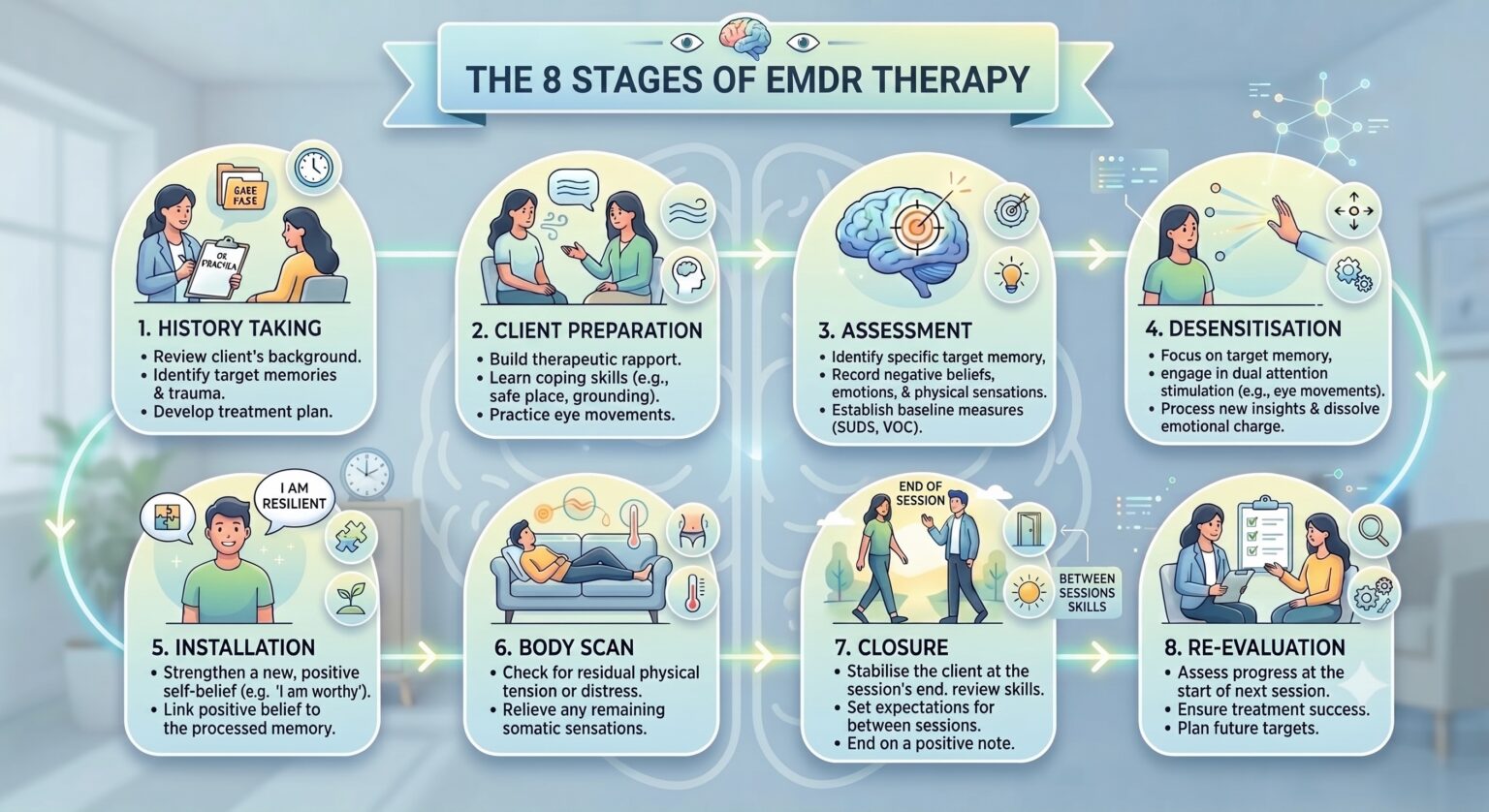
The 8 Phases of EMDR
EMDR follows a structured 8-phase approach. Every session is tailored to you — we move at a pace that feels safe and manageable.
History & Treatment Planning
We explore your history, identify the memories or experiences causing distress, and create a personalised treatment plan together.
Preparation
I teach you grounding and stabilisation techniques so you feel safe and equipped before we begin processing. No memory is approached until you feel ready.
Assessment
We identify the specific memory to target, the negative belief connected to it, and how you'd prefer to feel about it.
Desensitisation & Reprocessing
Using bilateral stimulation (guided eye movements, tapping or tones), your brain reprocesses the memory. Many clients notice the emotional intensity reducing significantly within sessions.
Evaluation
We review progress, ensure the processing is complete, and consolidate the positive changes you've experienced.
You don't have to have a diagnosis
to benefit from EMDR.
EMDR is effective for a wide range of conditions — from diagnosed PTSD to distressing memories that simply won't let go.

Trauma & PTSD
Single-event trauma, complex trauma, childhood experiences, accidents, assault, or medical trauma.

Anxiety & Panic
Generalised anxiety, panic attacks, social anxiety and high-functioning anxiety.

Disturbing Memories
Memories that feel vivid, intrusive or emotionally overwhelming — even years after the event.

Depression
Particularly where depression is rooted in unresolved past experiences or a negative self-belief.

OCD
Obsessive-compulsive patterns that are driven by underlying anxiety or traumatic memories.

Addiction
Where addictive patterns are linked to unresolved trauma, emotional pain or distressing memories.

Fibromyalgia
EMDR has shown promising results in reducing pain and distress in fibromyalgia sufferers.

Phobias
Specific phobias rooted in past experiences or traumatic events.

Low Self-Esteem
Deeply held negative beliefs about yourself that were formed through difficult experiences.
A safe, structured and
compassionate process.
Many people come to EMDR feeling nervous — particularly if they've had difficult experiences with other therapies, or feel anxious about revisiting painful memories. Here's what you can expect when working with me.
30 years of experience.
EMDR from the very beginning.
I'm Trevor Beech, BACP BACP-registered psychotherapist and EMDR specialist. I've been working with clients experiencing trauma, anxiety and distressing memories for over three decades, and EMDR has been central to my practice throughout.
I work with individuals from all walks of life — professionals, executives, business owners, and people who simply want to stop being held back by their past. My approach is warm, non-judgemental and entirely tailored to you.
I offer EMDR therapy online. An initial conversation gives us the chance to talk about what you're experiencing and whether EMDR is the right approach for you — with no pressure and no obligation.
BACP Registered Psychotherapist EMDR Trauma Specialist 30 Years in Private Practice Cognitive Behavioural Therapy (CBT) Business & Executive Coach"If you choose Trevor, you will feel understood, listened to, accepted, supported, encouraged, and, I have no doubt, in the end, a brand-new person."
Common Questions
Ready to take
the first step?
Get in touch and let's talk about whether EMDR is right for you.
No obligation. No pressure. Just a calm, honest conversation.
Get in Touch Send an EnquiryOr call Trevor directly: 07818 420 123 · info@trevorbeech.com