At first glance, someone with high-functioning anxiety can look like the most capable person in the room. They meet every deadline, rarely say no, and seem to thrive under pressure. But beneath that composed, high-achieving exterior, a very different experience is often taking place.
What Is High-Functioning Anxiety?
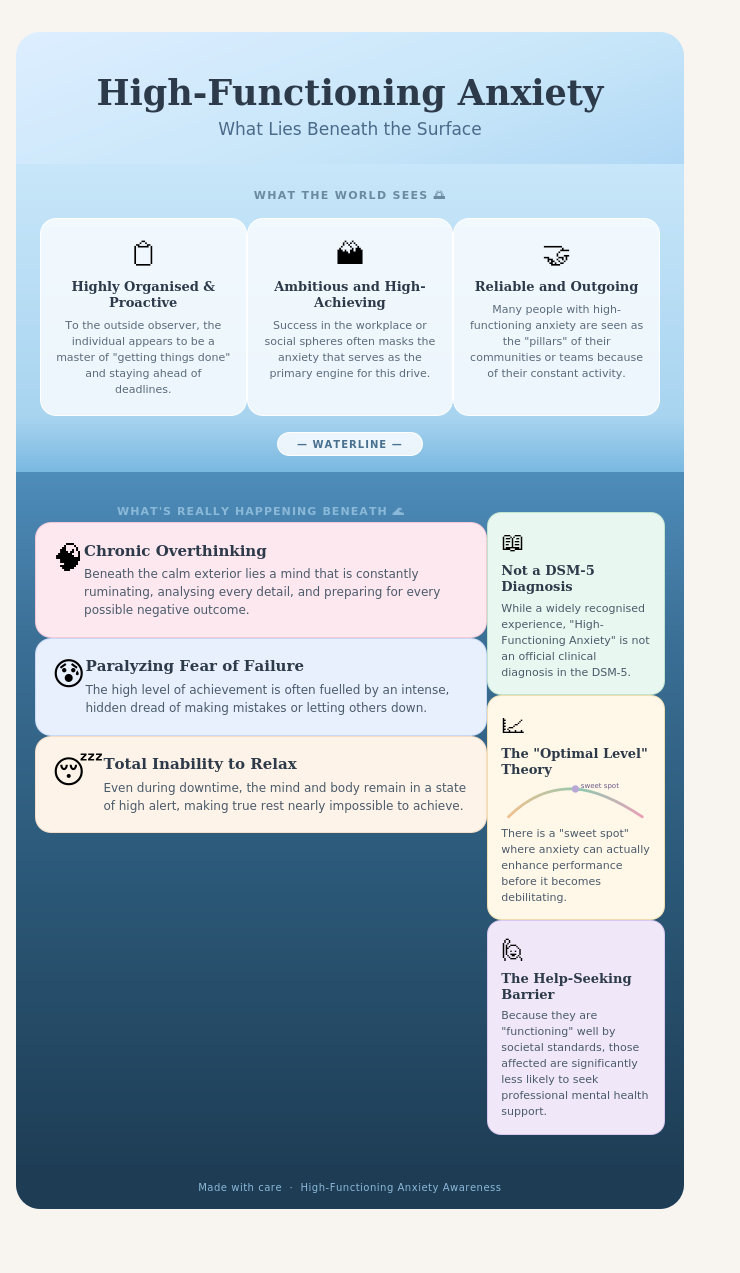
High-functioning anxiety is not a formal clinical diagnosis ‚ it does not appear in the Diagnostic and Statistical Manual of Mental Disorders (DSM-5). Instead, it is a widely used term to describe individuals who live with the internal symptoms of anxiety while continuing to perform well in their daily lives. Their anxiety does not visibly impair their functioning; in fact, it often drives it.
This distinction matters. Because these individuals appear to be coping ‚ or even thriving ‚ their anxiety frequently goes unrecognised, both by others and by themselves.
What It Looks Like on the Surface
People with high-functioning anxiety are often described by those around them as organised, reliable, and ambitious. They tend to be the ones who arrive over-prepared, anticipate problems before they arise, and take on more than their fair share of responsibility. In social and professional settings, they are frequently perceived as confident and dependable.
These traits are real ‚ but they are often fuelled by anxiety rather than ease.
What Is Happening Beneath the Surface
While the outward presentation can appear calm and controlled, the internal experience is typically the opposite. Common features include:
Chronic overthinking ‚ a near-constant cycle of rumination, worst-case scenario planning, and self-analysis that rarely switches off.
Fear of failure ‚ a persistent, often disproportionate dread of making mistakes or disappointing others, which underlies much of the drive to overperform.
Inability to relax ‚ even during rest or leisure time, the nervous system remains on high alert, making genuine recovery difficult to achieve.
Why It Often Goes Unaddressed
Research into help-seeking behaviour consistently shows that people are less likely to seek support when they believe their difficulties are not “serious enough.” For those with high-functioning anxiety, the very fact that they are managing ‚ holding down jobs, maintaining relationships, meeting expectations ‚ can become a barrier to getting help. There is often an internal narrative that says, “I’m coping, so I must be fine.”
This is compounded by what psychologists sometimes refer to as the “optimal level” theory of anxiety: the idea that a moderate degree of anxiety can genuinely enhance performance, focus, and motivation. While this is supported by evidence (the Yerkes-Dodson law describes this inverted-U relationship), it can make it difficult for individuals ‚ and those around them ‚ to recognise when anxiety has shifted from useful to harmful.